State Cowboy is named for the cattle drives across Indian Territory, and for the highway that later crossed the same country. It is not a university mark, and it is not an office of the State of Oklahoma.
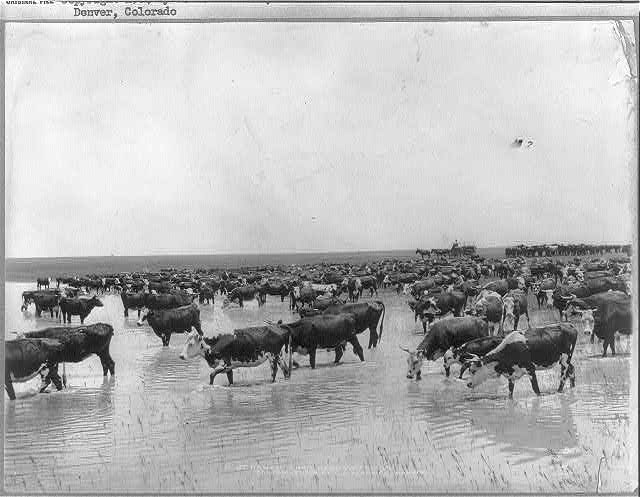
From the 1840s, Texas herds crossed eastern Indian Territory on the Shawnee Trail. They forded the Red River near Preston, Texas, passed Boggy Depot and Fort Gibson, and went on toward Missouri. Farmers there often stopped them. The longhorns carried ticks, and the ticks spread Texas fever to local cattle.
The main route then moved west. In 1867 Joseph G. McCoy opened stockyards at Abilene, Kansas. Drovers reached them through central Indian Territory on the trail named for Jesse Chisholm, a part-Cherokee trader. Herds crossed the Red River at Red River Station, near present-day Ringgold, Texas. Abilene was the railhead until 1871. Later drives ended at Newton, Wichita, and Caldwell. The Encyclopedia of Oklahoma History and Culture gives an estimate of about six million head for the life of that trail.
In 1874 John T. Lytle opened the route that became the Great Western Trail, also called the Western Trail and the Dodge City Trail. Herds forded at Doan's Crossing, near Vernon, Texas, and went north through western Indian Territory, past the sites of Clinton and Woodward. In 1881 more than 300,000 longhorns passed Doan's store. The same encyclopedia says the trail carried more than two million cattle, stayed busy until 1891, and was last recorded in use in 1894. Fences, a Kansas quarantine against Texas cattle, and new farms closed the open drives.
Route 66
In November 1926 the United States approved a numbered highway system. Cyrus Avery of Tulsa had chaired the Oklahoma highway commission, and he pressed for a road from Chicago to Los Angeles through Tulsa and Oklahoma City. Oklahoma designated that road, U.S. 66, on December 7, 1926.
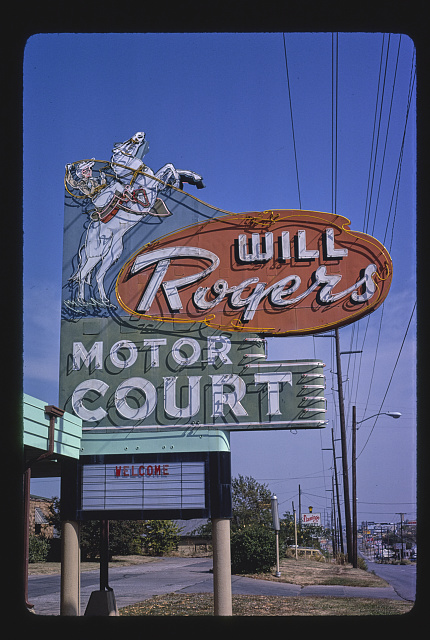
From the Kansas line it ran through Miami, Vinita, Claremore, Tulsa, and Oklahoma City, then west through El Reno, Clinton, Elk City, and Texola into Texas. Gas stations, motor courts, and cafes lined it. In 1937 the last unpaved stretch in Oklahoma, west of Miami, was opened. In 1985 the number was retired. Parts of the old road are still driven.
The trail account follows the Encyclopedia of Oklahoma History and Culture on cattle drives, the Chisholm Trail, and the Western Trail. The highway account follows that encyclopedia's entry on Route 66 and the City of Oklahoma City's note on the December 7, 1926 designation.