Oklahoma · Est. 1889
The Land Run of 1889
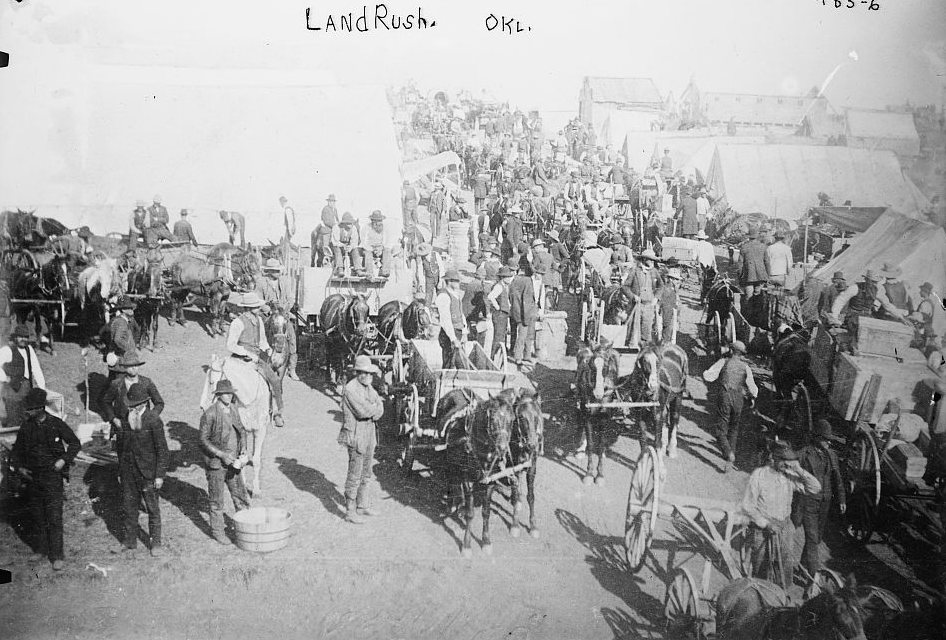
At noon on April 22, 1889, the United States opened the Unassigned Lands in Indian Territory to homestead settlement. About fifty thousand people were on the line. By nightfall, Guthrie and Oklahoma City were towns. The words Boomer and Sooner come from that history, and they do not mean the same thing.
The Unassigned Lands
The tract was about 1.9 million acres in the center of what is now Oklahoma, sometimes called the Oklahoma District. It was not empty country in any honest sense. It had belonged to the Muscogee (Creek) and Seminole nations. After the Civil War, the United States required those nations to cede it in the treaties of 1866, treating factions that had allied with the Confederacy as a cause to reduce their domain. The land was not then assigned to another Native nation. Settlement by non-Indians was forbidden, and the Army turned colonists back.
In 1879 Elias C. Boudinot, a Cherokee attorney, argued in print that the tract was public land open to homesteaders. David L. Payne put that claim to a test. He led colonies onto the district. Soldiers removed them, and Payne was jailed. He died in 1884. William L. Couch then led the Boomer movement. The colonies camped the borders of Kansas and the Indian nations and crossed when they could. The last recorded Boomer colony was turned out in October 1885. Their object was political as well as personal: to force Congress to open the land.
The act and the proclamation
On March 2, 1889, Congress approved the Indian Appropriations Act for the coming year. Sections 12 and 13 of that act dealt with these lands. The United States paid the Seminole Nation for the remaining claim under the treaty of 1866. The Seminole release was executed on March 16, 1889. The act also recited the earlier cession by the Muscogee (Creek) Nation. It declared the acquired land part of the public domain, to be disposed of to actual settlers under the homestead laws, and only after the President proclaimed an opening.
The statute was explicit. Until that proclamation, no person was permitted to enter upon and occupy the land. Anyone who violated the provision was barred from acquiring any right to it. That language became known as the sooner clause. Homesteads were limited to a quarter section, 160 acres. Sections 16 and 36 of each township were reserved for public schools. Townsites, once the opening was proclaimed, could not exceed a half section.
President Benjamin Harrison signed Proclamation 288 on March 23, 1889. He fixed the hour: twelve o'clock noon, Monday, April 22, 1889.
Noon, April 22
Through early April the borders filled. People gathered at Arkansas City and Caldwell on the Kansas line, at Purcell to the south, and along the Canadian River and the Cheyenne and Arapaho boundary. At Fort Reno a cannon gave the signal. Elsewhere the start was a gunshot or a bugle. Trains of the Santa Fe, which already crossed the district, carried others to the stations.
About fifty thousand men, women, and children made the run. A homestead was a race of horses, wagons, and people on foot to a stake in the prairie. Guthrie had been a railroad station called Deer Creek, named in the new town for John Guthrie, a Kansas jurist. Oklahoma City stood at Oklahoma Station. By sunset each held on the order of ten thousand people, most of them in tents. Kingfisher, Norman, El Reno, and Stillwater were begun the same day. The land offices for the district were at Guthrie and Kingfisher.
The Boomer story
Boomer is the older word. It belongs first to David L. Payne, William L. Couch, and the people who, from the late 1870s through the middle 1880s, camped the border of the Unassigned Lands and agitated to have them opened. Soldiers removed the colonies. Payne died in 1884, and Couch carried the movement on. The last recorded Boomer colony was turned out in October 1885.
On April 22, 1889, the word also describes the settlers who held that line until noon and went when the law allowed. Okie Titles uses Oklahoma Boomer for that record: the camps, the pressure, and the lawful start. It is not the Sooner title.
The Sooner story
Sooner named a different act on the same day. Some people slipped into the district before the noon signal and hid in the brush and the draws, then appeared to stake claims once the run was underway. President Harrison's proclamation, and the sooner clause in the act of March 2, 1889, denied them any right to the land. Early claimants were also called moonshiners, because they had come in by moonlight. The advantage was real, and it produced years of contests before the General Land Office and the courts.
Some railroad workers and federal officers were already inside by duty, and their chance to claim was disputed as well. The word on this certificate is the plain one. A Sooner, in the language of that day, was a person who crossed before noon to take land contrary to the opening. The early settlers of the Territory held the name in low regard. In later years Oklahomans took it up, and the state came to be called the Sooner State. The reproach and the nickname are the same word at two times. They are not a cheer, and they are not the Boomer title.
The later openings
The run of 1889 was the first, not the last. The later openings were of a different kind of land. These were surplus acres of reservations whose nations had been pressed into allotment, often for very little money, with the remainder sold to the United States and then raced for by non-Indian settlers.
- September 22, 1891. Surplus lands of the Iowa, the Sac and Fox, the Citizen Potawatomi, and the Absentee Shawnee, more than nine hundred thousand acres. The Iowa had accepted eighty-acre allotments in 1890 and sold the rest for less than twenty-eight cents an acre. The Sac and Fox received $1.23 an acre for their surplus. The Citizen Potawatomi and the Absentee Shawnee sold theirs at sixty-nine cents an acre. About twenty thousand people lined the boundaries for 6,097 homesteads. The Kickapoo refused allotment at that time.
- April 19, 1892. The former Cheyenne and Arapaho Reservation, about 3.5 million acres, after individual allotments of 160 acres. About twenty-five thousand people ran at noon. Most of the land was still unclaimed when the day ended.
- September 16, 1893. The Cherokee Outlet, often called the Cherokee Strip, though the Outlet is the accurate name of the tract. Treaties of 1828 and 1835 had guaranteed the Cherokee a perpetual western outlet. After the Civil War the United States reduced that guarantee, and for years cattlemen leased the grass from the Cherokee Nation. President Grover Cleveland then proclaimed the opening of some six million acres. About one hundred thousand people ran. It was the largest of the runs.
- May 23, 1895. The Kickapoo surplus, the last opening made by a run. The Kickapoo had refused the offers of 1890. A later agreement, which the historical record describes as obtained by unfair means, allotted eighty acres to each of 283 Kickapoo and exposed the remainder. After school lands were reserved, 550 quarter sections remained for homesteads. About ten thousand people competed, and sooners were again thick on the ground.
Later reservations were opened by lottery and by bid, precisely because the run had rewarded those who broke the line.
Statehood
On November 16, 1907, Oklahoma Territory and Indian Territory were joined as the forty-sixth state. The name Oklahoma is from the Choctaw words okla and homma, “people” and “red.” Statehood did not restore the lands the runs had parceled out. It closed the territorial period in which those takings were carried out, one proclamation at a time.
Okie
Okie is a shortening of Oklahoman. It was in use by the early years of the twentieth century. During the drought and the migration of the 1930s the word was turned into a slight, applied in California to people leaving the southern plains, whether or not they were from this state. John Steinbeck's The Grapes of Wrath, published in 1939, fixed that picture in the national memory. Oklahomans kept the name. Oklahoma Okie is our certificate for a name connected to this place. It is not an office.
The trails, and State Cowboy
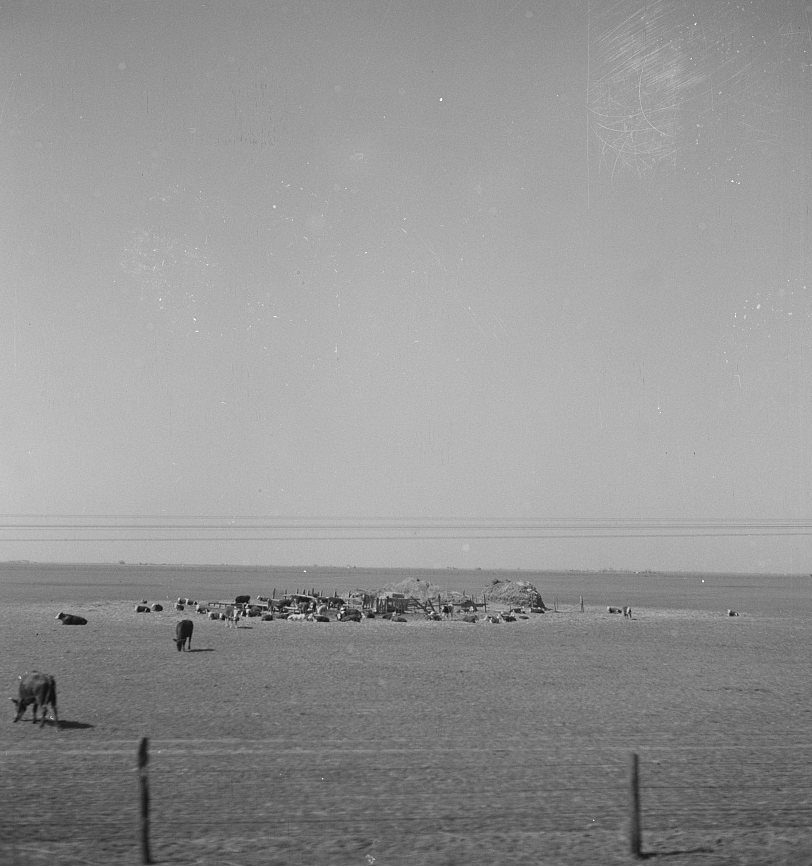
Before the farms, the long trails crossed Indian Territory from south to north. From the late 1860s into the 1880s, cowboys drove Texas cattle up the Chisholm Trail and the other trails to the railheads in Kansas. Herds were grazed on leased grass, including the Cherokee Outlet, and then shipped east. That mounted work, the hat, the horse, and the drive, is the heritage named by State Cowboy.
The certificate is printed in orange and black because those are the colors reserved here for the western title. It is not a commission of the State of Oklahoma, and it carries no university mark.
The record used here
This account follows President Harrison's Proclamation 288 of March 23, 1889, the Indian Appropriations Act of March 2, 1889, and the Encyclopedia of Oklahoma History and Culture, including its entries on Guthrie, the Sac and Fox opening, the Cheyenne-Arapaho opening, the Kickapoo opening, Sooners, and the word Okie. The figure of about fifty thousand participants, and of about ten thousand in Guthrie and in Oklahoma City by nightfall, is the estimate given by the U.S. Census Bureau. The Boomer colonies are as described in the Encyclopedia of the Great Plains.