For a family that has been here a long time, or for someone who just got here.
The colors on this certificate are for the country around the name.
Sky, the sky
Woods, forests and woodlands
Clay, the red earth
Prairie, prairies and deserts
Water, the water
Okie Titles
Oklahoma
No. OT-5J8P-0001
Certificate of Title
The name written below is entered in the register of Okie Titles and is recognized under the commemorative title set forth.
The name entered
is entered under the title of
Oklahoma Okie
For a name tied to Oklahoma
Date of issue
D.K. Heinz NeumannRegistrar, Okie Titles
Otis BrunerWitness
A commemorative novelty title. It confers no legal right, land, office, or affiliation with any government or university.
PREVIEW ONLY · OKIETITLES.COMPREVIEW ONLY · OKIETITLES.COMPREVIEW ONLY · OKIETITLES.COMPREVIEW ONLY · OKIETITLES.COMPREVIEW ONLY · OKIETITLES.COMPREVIEW ONLY · OKIETITLES.COMPREVIEW ONLY · OKIETITLES.COMPREVIEW ONLY · OKIETITLES.COMPREVIEW ONLY · OKIETITLES.COMPREVIEW ONLY · OKIETITLES.COMPREVIEW ONLY · OKIETITLES.COMPREVIEW ONLY · OKIETITLES.COMPREVIEW ONLY · OKIETITLES.COMPREVIEW ONLY · OKIETITLES.COMPREVIEW ONLY · OKIETITLES.COMPREVIEW ONLY · OKIETITLES.COMPREVIEW ONLY · OKIETITLES.COMPREVIEW ONLY · OKIETITLES.COMPREVIEW ONLY · OKIETITLES.COMPREVIEW ONLY · OKIETITLES.COMPREVIEW ONLY · OKIETITLES.COMPREVIEW ONLY · OKIETITLES.COMPREVIEW ONLY · OKIETITLES.COMPREVIEW ONLY · OKIETITLES.COM
The certificate updates as you type the name and the date.
Oklahoma Okie is the certificate for a name connected to this place. Okie started as a short way of saying Oklahoman. In the 1930s people used it as a slight. A lot of Oklahomans kept it anyway.
It is a commemorative certificate. It does not make anyone an official, and it is not a deed.
Every order includes a PDF download. Unframed and framed pieces are printed by Gelato on heavy matte paper, with US shipping included.
Okie Titles
Oklahoma
No. OT-5J8P-0001
Certificate of Title
The name written below is entered in the register of Okie Titles and is recognized under the commemorative title set forth.
The name entered
is entered under the title of
Oklahoma Okie
For a name tied to Oklahoma
Date of issue
D.K. Heinz NeumannRegistrar, Okie Titles
Otis BrunerWitness
A commemorative novelty title. It confers no legal right, land, office, or affiliation with any government or university.
PREVIEW ONLY · OKIETITLES.COMPREVIEW ONLY · OKIETITLES.COMPREVIEW ONLY · OKIETITLES.COMPREVIEW ONLY · OKIETITLES.COMPREVIEW ONLY · OKIETITLES.COMPREVIEW ONLY · OKIETITLES.COMPREVIEW ONLY · OKIETITLES.COMPREVIEW ONLY · OKIETITLES.COMPREVIEW ONLY · OKIETITLES.COMPREVIEW ONLY · OKIETITLES.COMPREVIEW ONLY · OKIETITLES.COMPREVIEW ONLY · OKIETITLES.COMPREVIEW ONLY · OKIETITLES.COMPREVIEW ONLY · OKIETITLES.COMPREVIEW ONLY · OKIETITLES.COMPREVIEW ONLY · OKIETITLES.COMPREVIEW ONLY · OKIETITLES.COMPREVIEW ONLY · OKIETITLES.COMPREVIEW ONLY · OKIETITLES.COMPREVIEW ONLY · OKIETITLES.COMPREVIEW ONLY · OKIETITLES.COMPREVIEW ONLY · OKIETITLES.COMPREVIEW ONLY · OKIETITLES.COMPREVIEW ONLY · OKIETITLES.COM
The certificate updates as you type the name and the date.
The word
Okie is a short way of saying Oklahoman. The Encyclopedia of Oklahoma History and Culture notes that people were already using it by 1905, the way they said Arkie for Arkansas. It was not an insult then.
The 1930s made it one. Drought and the Depression pushed people off farms. The worst dust was in the Panhandle. On April 14, 1935, a black storm hit Guymon, and a reporter there put the words "dust bowl" into print for that country: the Oklahoma and Texas panhandles and the neighboring plains of Kansas, Colorado, and New Mexico. Cimarron County and Texas County took the hardest of it. Those counties were thinly settled. They were not where most of the people who left Oklahoma had lived.
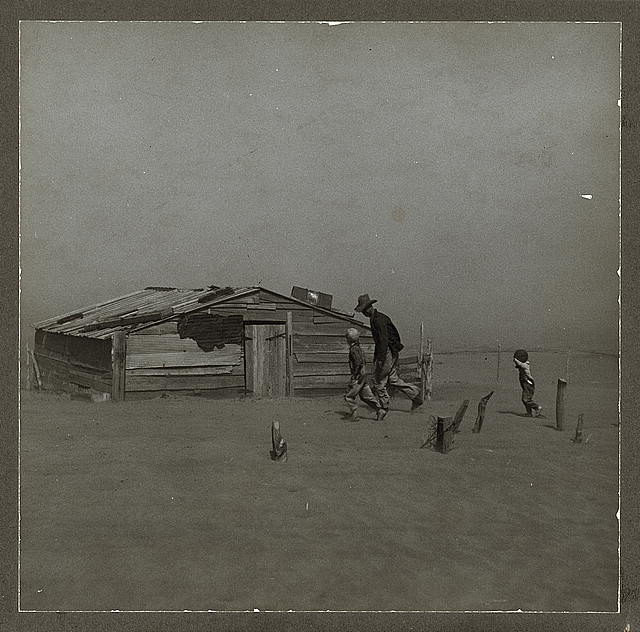
Arthur Rothstein, a farmer and his sons walking into a dust storm, Cimarron County, April 1936. Farm Security Administration. Library of Congress. No known restrictions.
Most of the families who left were tenant and sharecropper cotton farmers from the east and the south of the state. Landlords, a ruined cotton price, machines, and New Deal payments that went to owners for taking land out of production put them on the road. Some went to California to pick crops. Others stopped in towns closer to home.
In California the short name became a slight. It was stuck on migrant farm workers from the southern plains, including people who had never lived in Oklahoma. The encyclopedia credits Ben Reddick, a newspaperman in Paso Robles, with writing "Okies" on a photograph of cars carrying Oklahoma plates. The caption spread.
John Steinbeck's novel The Grapes of Wrath, published in 1939, made one family, the Joads, stand for that journey. In the book a bank forces them off the land. That was not how most of the real departures happened. The picture stuck anyway.
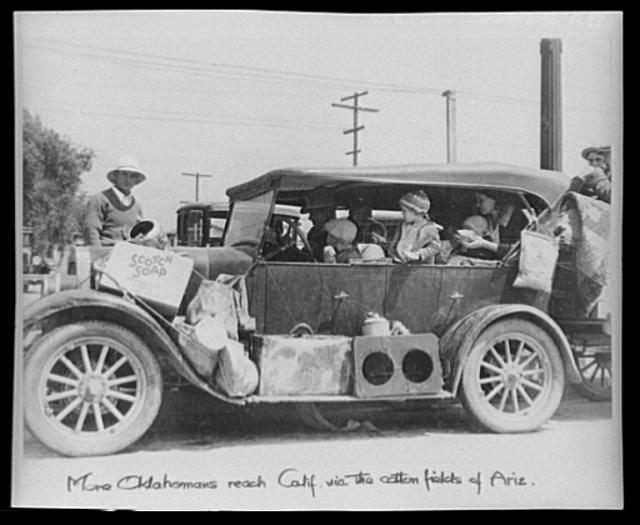
Dorothea Lange, Oklahoma refugees in San Fernando, California, June 1935. The file print notes that they came by way of the Arizona cotton fields. Farm Security Administration. Library of Congress. No known restrictions.
Woody Guthrie was born in Okemah. He met the dust storms later, in Pampa, Texas, where he had gone to live with his father. In 1940 he recorded Dust Bowl Ballads. The songs describe the storms and the people on the road to California. He was called Oklahoma's Dust Bowl balladeer, though the storms he was singing from were in the Texas Panhandle, and many of the migrants in the songs were cotton farmers from the east and south of this state.
Merle Haggard was born in 1937 in Oildale, near Bakersfield, California. His parents, Jim and Flossie, had left a farm near Checotah in 1935 after drought and a barn fire. In 1969 he released "Okie from Muskogee." The song describes someone from that town who prefers a plain, small-town life and rejects the campus protests and the drug culture of the late 1960s. A lot of Oklahomans heard it as pride. Haggard later gave more than one account of what he had meant: a light song, his father's point of view, or a patriotic one. People who had lived with the insult did not all agree to take the word back. Many did. It is now an ordinary name for someone from here, and in some places it is still a slight. This certificate uses it as the plain name.
The country
A lot of the soil is red clay, colored by iron. The east and the north are tallgrass prairie. Toward the Panhandle the grass is shorter, and the wind has more room.
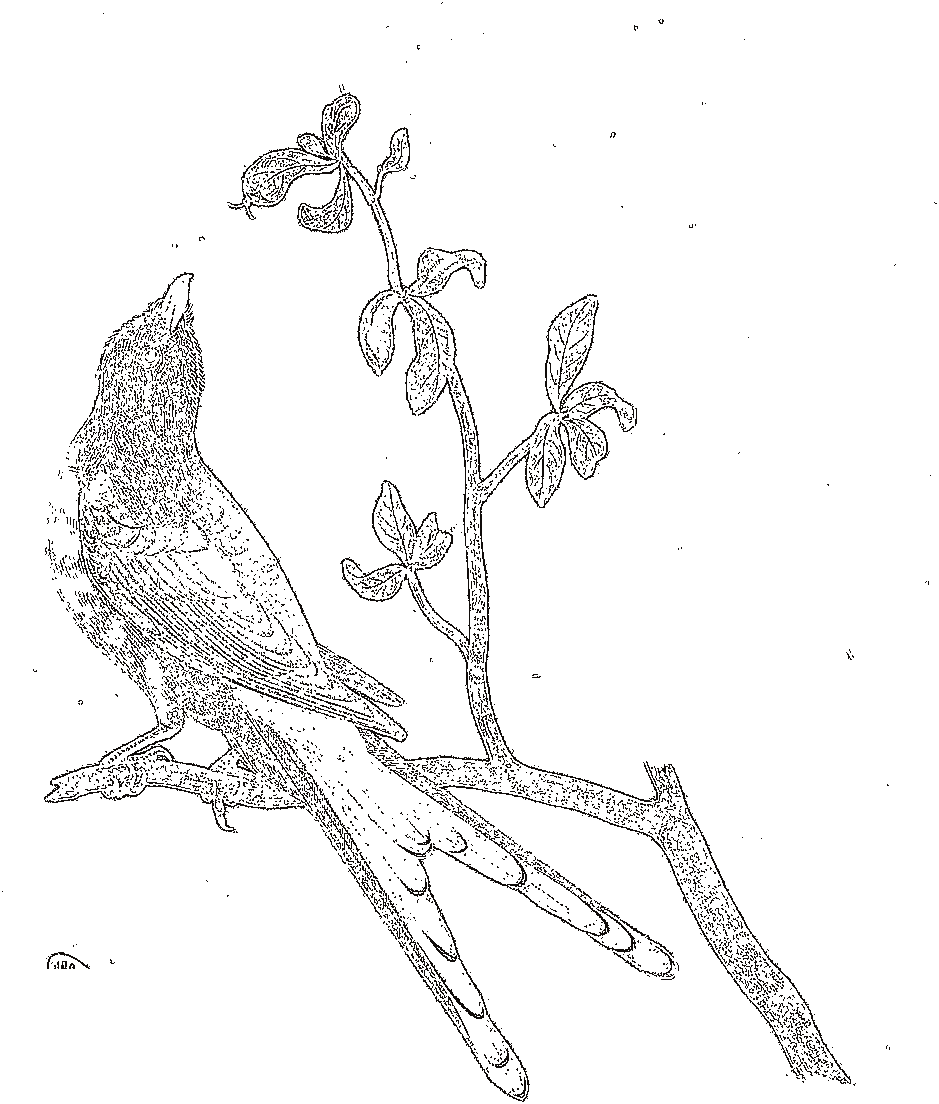
The scissor-tailed flycatcher has been the state bird since 1951. It is gray above, pale underneath, and the tail is a long fork. The eastern redbud has been the state tree since 1937. It flowers pink before the leaves come out. Indian blanket, also called firewheel, has been the state wildflower since 1986. The petals are red with yellow tips. These are living things, not a seal, a logo, or a wordmark.
Hospitality here is the practical kind. People feed a guest and make time to sit with them.
The account of the word follows the Encyclopedia of Oklahoma History and Culture on Okie, the Dust Bowl, Woody Guthrie, and Merle Haggard, and the Smithsonian's record of the Haggard family's move from McIntosh County. The birds and plants are the state symbols named by the Oklahoma Historical Society, adopted in 1951, 1937, and 1986.